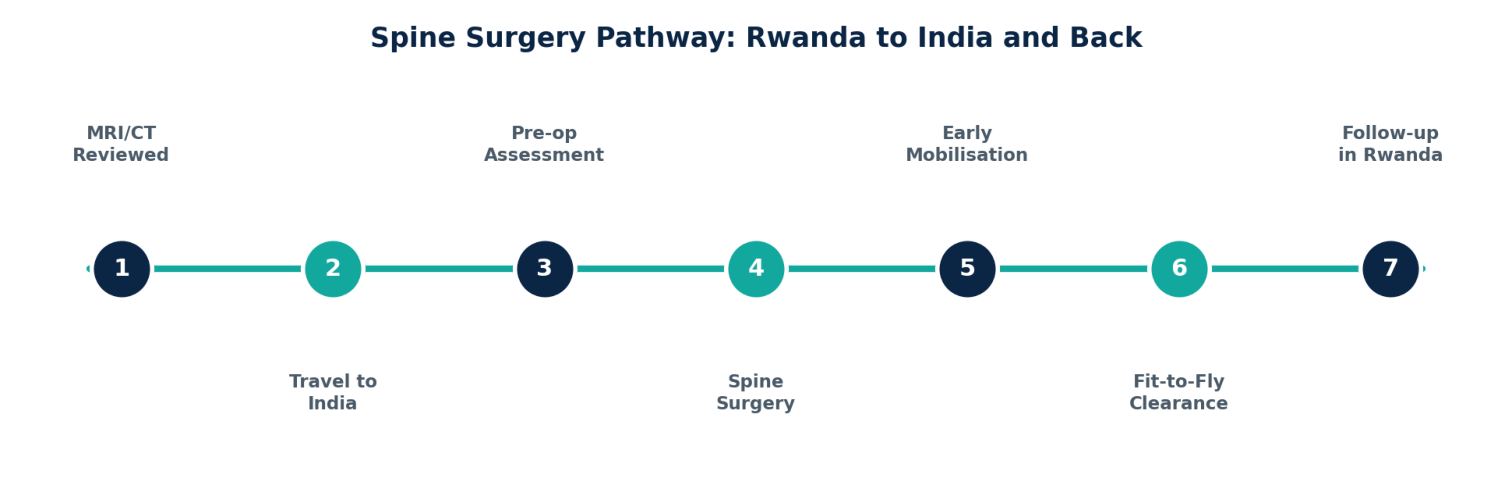
Spine surgery in India can suit Rwanda patients when the diagnosis is clear and surgery is genuinely needed — not every spine problem requires an operation. The right procedure, from microdiscectomy and decompression to fusion, ACDF, disc replacement, minimally invasive, endoscopic or navigation-assisted surgery, depends on your exact diagnosis. Plan for recovery in India, fit-to-fly clearance for the journey home, complete medical records and structured follow-up in Rwanda.
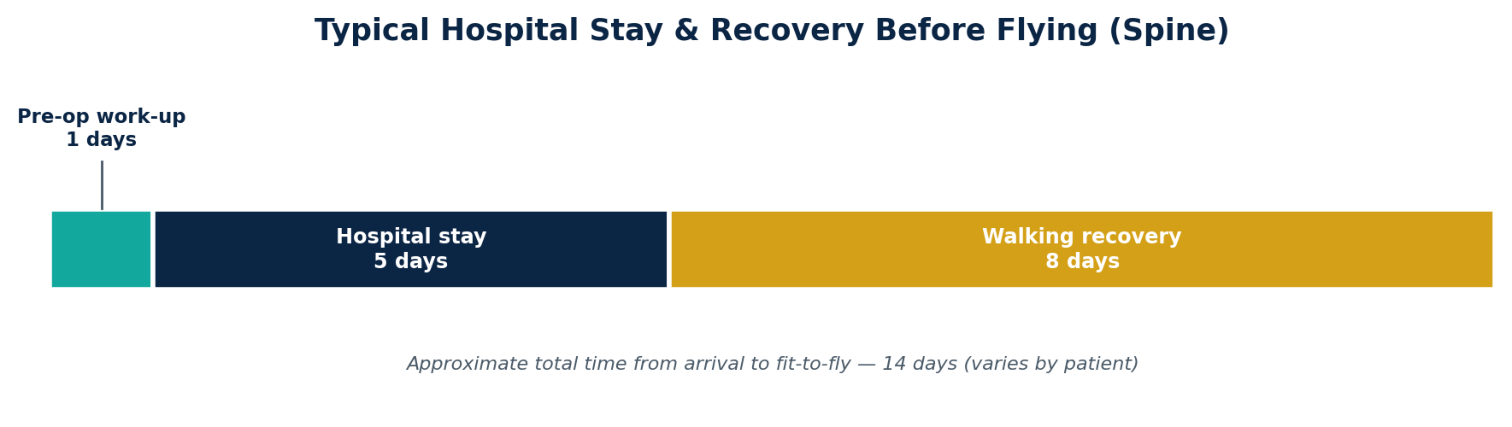
4–6 DaysTypical hospital stay after major spine surgery
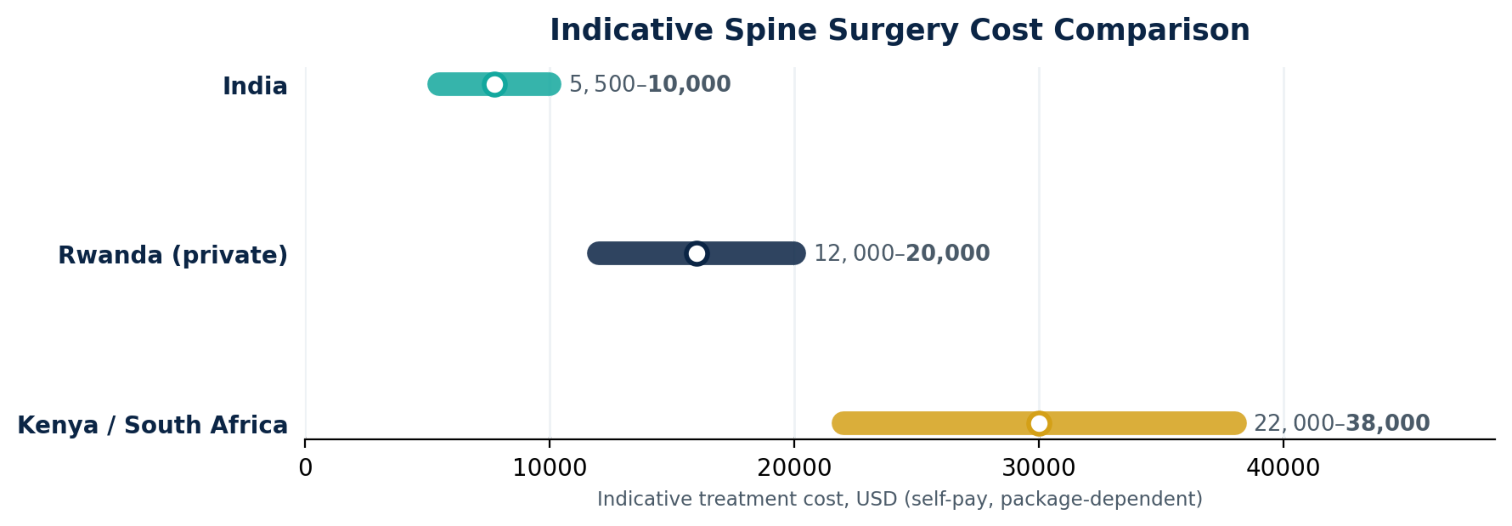
45–65%Typical cost saving vs. Kenya / South Africa, package-dependent
For patients in Rwanda living with persistent back pain, neck pain, nerve compression, spinal deformity or another complex spine condition, surgery may become an option when symptoms are severe, neurological function is threatened, or appropriate non-surgical treatment has not provided sufficient relief. India offers a broad spectrum of spine procedures — from relatively focused operations such as microdiscectomy and decompression to complex spinal reconstruction, revision surgery, scoliosis correction, artificial disc replacement and minimally invasive or navigation-assisted procedures.
For a patient travelling from Rwanda, however, the important question is not simply “Can this surgery be performed in India?” The more useful questions are: Do I actually need surgery? Which operation is appropriate for my diagnosis? Is there a less invasive option? What technology is genuinely useful? What are the risks? How long will recovery take? And when will I be fit enough to make the journey back to Rwanda? This guide explains the clinical aspects of spine surgery in India from the perspective of Rwanda patients.
1. What Is Spine Surgery?
Spine surgery includes procedures performed on the vertebrae, spinal discs, spinal cord, nerve roots, ligaments and supporting structures of the cervical, thoracic or lumbar spine. The objective depends on the patient’s condition: relieving pressure on the spinal cord or nerves, stabilising an unstable segment, removing a damaged disc, correcting deformity, treating fractures, removing tumours, or draining infection. Spine surgery is therefore not one operation — the appropriate procedure depends heavily on the exact diagnosis.
2. Common Spine Conditions for Which Rwanda Patients May Consider Treatment in India
Herniated or Slipped Disc
A spinal disc can bulge or rupture and compress a nearby nerve, causing back pain, sciatica, leg or arm pain, numbness or weakness. Many disc problems improve without surgery; surgery becomes more relevant when nerve compression produces persistent disabling symptoms or neurological deficits.
Spinal Stenosis
Narrowing around the spinal canal or nerve roots can cause leg pain, heaviness, numbness or weakness, particularly while standing or walking. Treatment ranges from conservative management to decompression surgery depending on severity.
Degenerative Disc Disease
Age-related deterioration of spinal discs can produce chronic pain, instability or nerve compression. Not every abnormal disc seen on MRI requires surgery.
Spondylolisthesis
One vertebra slips relative to another. Mild cases may be treated conservatively; significant instability or nerve compression can require decompression and fusion.
Cervical Myelopathy
Compression of the spinal cord in the neck can affect walking, balance, hand function and fine movements, sometimes requiring surgical decompression to protect spinal-cord function.
Scoliosis and Spinal Deformity
Abnormal curvature, often with rotation, may require correction and stabilisation when severe, progressive, painful or associated with neurological problems.
Spinal Fractures and Instability
Trauma, osteoporosis or tumours can cause vertebral fractures; treatment depends on stability and neurological involvement.
Spinal Tumours and Infection
Tumours or infections affecting the spine may require decompression, drainage, debridement or stabilisation alongside oncological or antimicrobial therapy.
Failed Previous Spine Surgery
International patients also travel for revision surgery following persistent symptoms, implant problems, non-union or complications after previous surgery.
3. Does Every Condition Need Surgery?
No. This is one of the most important principles for a Rwanda patient considering travelling overseas. Depending on the diagnosis, appropriate non- surgical treatment may include:
Medication
Physiotherapy
Activity modification
Weight management
Structured exercise
Epidural injections or selective nerve-root blocks
The presence of an abnormality on MRI does not automatically mean surgery is necessary. A spine surgeon should evaluate whether the patient’s symptoms, physical examination and imaging findings correspond.
8. Minimally Invasive and Endoscopic Spine Surgery
Minimally invasive spine surgery uses smaller surgical corridors and specialised instruments, potentially offering smaller incisions, less muscle disruption and earlier mobilisation in appropriately selected patients. Endoscopic spine surgery goes further, using a camera through a very small access route for selected disc herniations. Neither approach is universally better — the technique should be selected because it suits the pathology, not because it sounds technologically advanced.
9. Robotic and Navigation-Guided Spine Surgery
Advanced Indian spine centres may use computer navigation, 3D imaging, robotic assistance and neuromonitoring to assist surgical planning and accurate implant placement in suitable cases. Technology does not replace the surgeon’s judgement or experience. A useful question for Rwanda patients is therefore not “Does this hospital have a spine robot?” but “Will this technology materially improve the planning, precision or safety of my particular operation?”
10. Risks and Possible Complications of Spine Surgery
Infection
Bleeding
Dural tear/CSF leak
Nerve injury
Neurological deterioration
Blood clots
Implant-related problems
Non-union after fusion
Persistent or recurrent pain
Adjacent-segment degeneration
Need for revision surgery
The risk profile of a straightforward single-level procedure is very different from that of complex revision or deformity surgery. Patients should request procedure-specific risk information rather than relying on generic complication percentages.
11. Recovery After Surgery
Early Phase
Pain control
Wound monitoring
Early mobilisation
Prevention of blood clots
Neurological assessment
Following Weeks
Progressive walking
Gradual increase in daily activities
Wound care
Medication reduction where appropriate
Physiotherapy when advised
Longer-Term Recovery
Patients undergoing fusion or complex reconstruction may require months for complete biological and functional recovery.
12. Physiotherapy and Rehabilitation
Walking and posture retraining
Core strengthening
Flexibility work
Functional movement retraining
Return-to-work conditioning
Neurological rehabilitation where relevant
13. When Can Patients Return to Work?
This depends on both the surgery and occupation. A patient with a desk-based job following a relatively small procedure may return much earlier than someone performing heavy physical work after fusion. Patients should discuss sitting tolerance, driving, lifting restrictions and return to full activity before leaving India.
14. How Long Should a Rwanda Patient Remain in India After Spine Surgery?
The appropriate period varies significantly. The decision should take into account the type of surgery, wound healing, ability to walk independently, neurological status, pain control, risk of complications, suture/staple removal, surgeon review and length of the return journey. A Rwanda patient should not book an inflexible return flight based solely on the expected hospital discharge date.
15. Flying Back to Rwanda After Spine Surgery in India
Fit-to-fly timing
Walking during the journey
Hydration
Blood-clot prevention
Compression stockings if appropriate
Medication timing
Lifting luggage
Airport wheelchair assistance
Suitable seating and wound care during travel
Patients at increased risk of venous thromboembolism may require individualised preventive measures.
16. What Medical Information Should You Take Back Home?
Discharge summary
Operative report
Final diagnosis
Relevant MRI/CT images
Postoperative imaging
Laboratory results
Histopathology if applicable
Implant details
Medication list
Physiotherapy instructions
Wound-care instructions
Follow-up schedule
Emergency warning signs
Treating surgeon’s contact/follow-up pathway
17. Follow-Up After Returning Home
Wound assessment
Neurological review
X-rays
MRI/CT when clinically indicated
Physiotherapy progression
Medication review
Assessment of fusion
Return-to-work planning
18. How Successful Is This Surgery?
There is no meaningful single “success rate” for spine surgery. Outcomes depend upon correct diagnosis, appropriate indication for surgery, severity of disease, duration of nerve compression, preoperative neurological deficit, age, general health, bone quality, previous surgery, procedure selected and rehabilitation. Patients should be cautious about websites offering one universal success percentage.
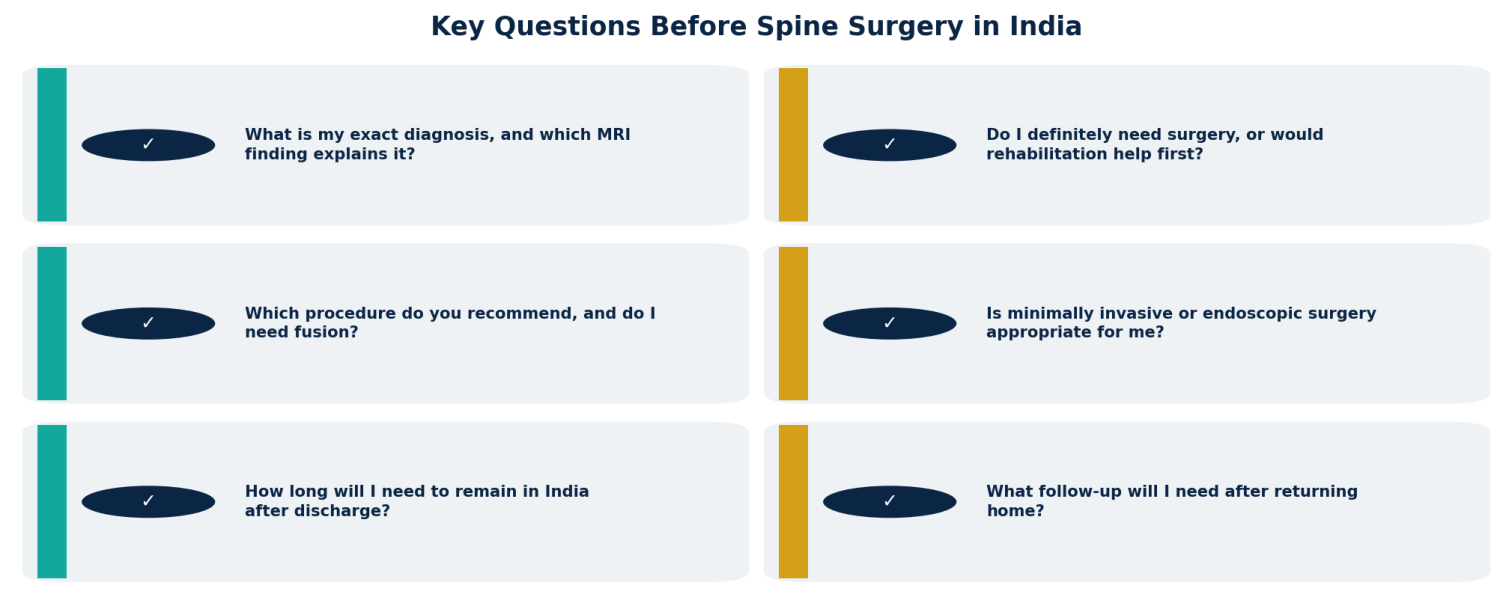
19. Questions Rwanda Patients Should Ask Before Agreeing to Surgery in India
What is my exact diagnosis?
Which MRI finding explains my symptoms?
Do I definitely need surgery?
What happens if I wait?
Are there reasonable non-surgical alternatives?
Which procedure do you recommend and why?
Do I need fusion?
Is minimally invasive or endoscopic surgery appropriate for me?
Will navigation or robotic technology provide a meaningful advantage?
What are the major risks in my specific case?
How long will I remain in India after discharge?
When will I be fit to fly back to Rwanda?
Frequently Asked Questions About Spine Surgery for Rwanda Patients in India
Can my spine MRI be reviewed before I travel from Rwanda?
Often, yes. Digital MRI/CT images, reports and clinical information can be reviewed before travel, though a definitive recommendation may still require physical examination and updated investigations.
Does a slipped disc always require surgery?
No. Many disc herniations improve with conservative treatment. Surgery is usually considered according to symptoms, neurological findings, duration and severity.
Is minimally invasive spine surgery better than open surgery?
Not automatically. It can offer meaningful benefits for appropriately selected procedures, but complex disease may be better treated through another approach.
Is robotic spine surgery available in India?
Selected centres use robotic and navigation-assisted technology. Its relevance depends upon the specific operation.
How soon can I fly back to Rwanda?
There is no universal timeframe. Your surgeon should clear you for travel based on the procedure, wound, mobility, neurological status and complication risk.
Can I continue physiotherapy in Rwanda?
Usually, yes. The Indian treating team should provide a rehabilitation protocol that can be shared with your physiotherapist in Rwanda.
What if I have already undergone spine surgery?
Revision surgery may still be possible. Send previous operative records, implant information and old and current imaging for assessment.
Should I choose a surgeon based on the technology offered?
No. Technology is one component. Procedure-specific surgeon expertise, correct diagnosis and postoperative care remain fundamental.
Key Takeaway for Rwanda Patients Planning Spine Surgery in India
Travelling from Rwanda to India for spine surgery is a significant decision. The most important step is not finding the most advanced- sounding operation, but establishing the correct diagnosis and determining whether surgery is genuinely required. When surgery is appropriate, the treatment should be matched to the pathology — decompression when nerves require decompression, stabilisation when the spine is unstable, deformity correction when clinically justified, and advanced technology when it provides a meaningful benefit. For a Rwanda patient, the treatment plan should also extend beyond the operating room to cover recovery in India, fitness for travel, rehabilitation in Rwanda, and a clear pathway for follow-up after returning home.
Rwanda Patients — Ready to Take the First Step?
Share your medical reports from Rwanda with our advisory team today and get a MEDICAL CONSULTATION, an indicative cost estimate in US$, and complete support — from your flight out of Kigali to your recovery in India and follow-up back home.