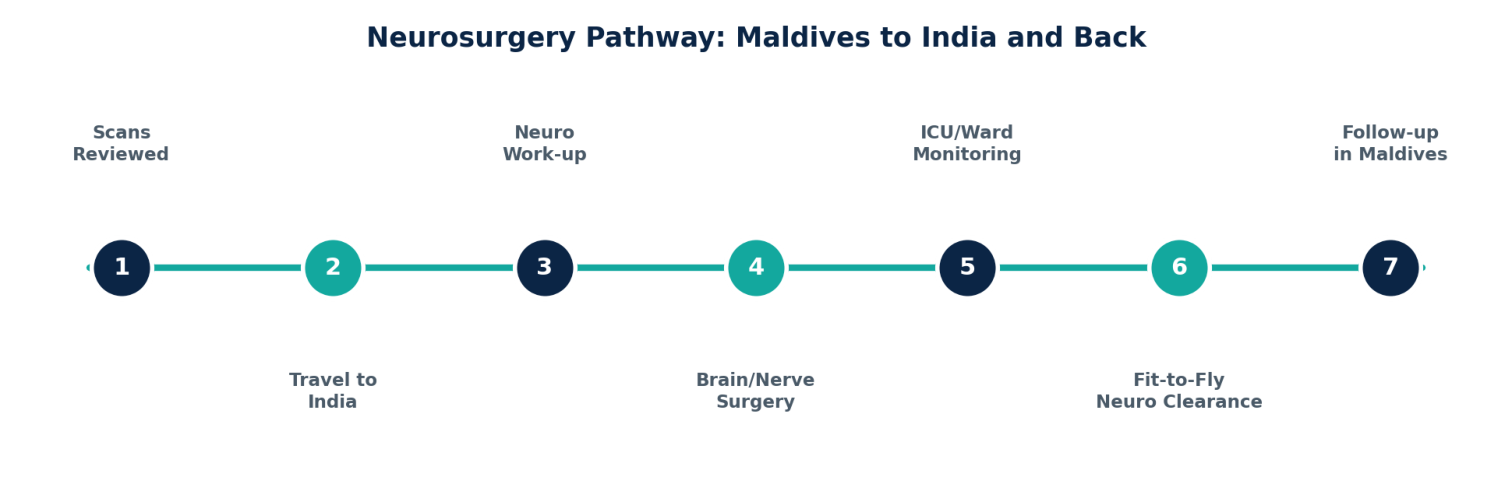
Neurosurgery in India can suit Maldives patients when the diagnosis is clear and surgery is genuinely needed — not every brain tumour or neurological condition requires an operation. The right treatment, from craniotomy and endoscopic neurosurgery to Gamma Knife or CyberKnife radiosurgery, deep brain stimulation or endovascular procedures, depends on your exact diagnosis. Plan for recovery and neuro-rehabilitation in India, neurological fit-to-fly clearance for the journey home, complete medical records and structured follow-up in Maldives.
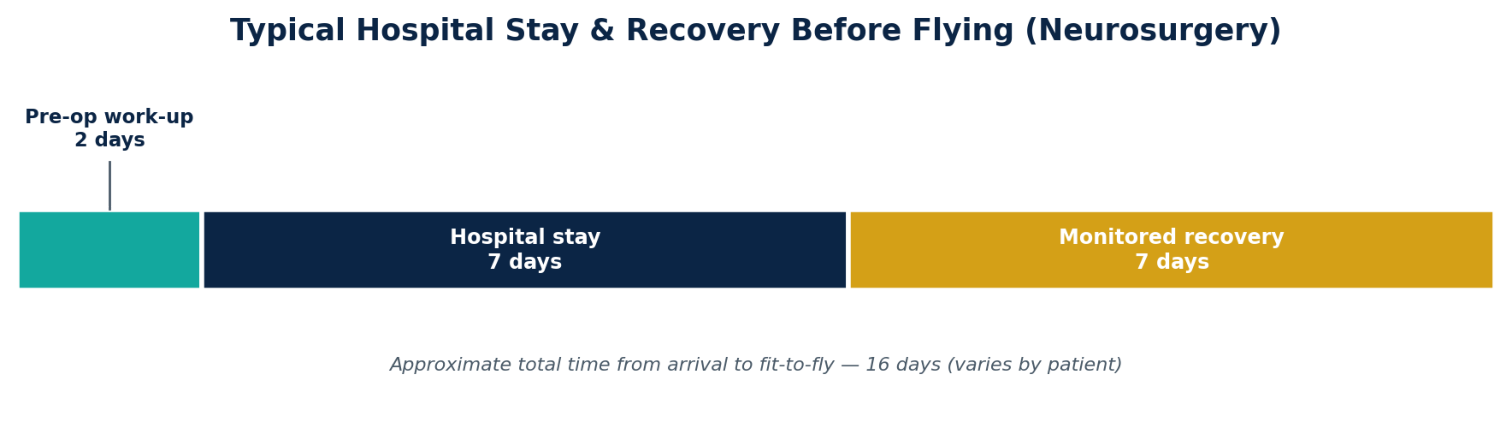
7–10 DaysTypical hospital stay after major brain/nerve surgery
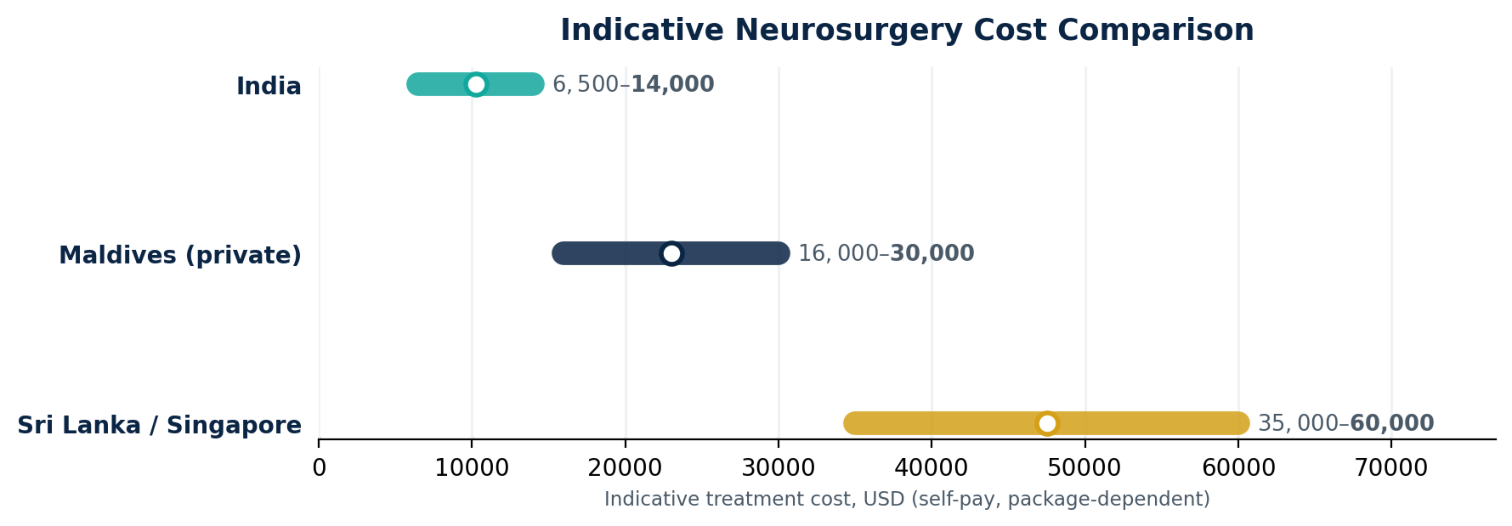
50–70%Typical cost saving vs. Sri Lanka/Singapore, package-dependent
For patients in Maldives living with a brain tumour, nerve compression, a vascular brain condition, or another complex neurological problem, surgery may become necessary when symptoms are severe, neurological function is threatened, or appropriate non-surgical treatment has not provided sufficient relief. India offers a broad spectrum of neurosurgical care — from brain and spinal tumour removal to aneurysm treatment, epilepsy surgery, functional neurosurgery, and advanced radiosurgery such as Gamma Knife and CyberKnife.
For a patient travelling from Maldives, however, the important question is not simply “Can this be treated in India?” The more useful questions are: Do I actually need surgery? Which treatment is appropriate for my exact diagnosis? Is there a less invasive option, such as radiosurgery? What are the risks? How long will recovery take? And when will I be fit enough, neurologically, to make the long journey back to Maldives? This guide explains the clinical aspects of neurosurgery in India from the perspective of Maldives patients.
1. What Is Neurosurgery?
Neurosurgery covers procedures performed on the brain, spinal cord, peripheral nerves and their surrounding structures. The objective depends heavily on the diagnosis: removing or treating a tumour, relieving pressure on the brain or nerves, repairing a blood vessel abnormality, controlling seizures, or restoring function affected by a structural or degenerative condition. Neurosurgery is therefore not one operation — the appropriate approach depends on the exact diagnosis, its location, and the neurological function it affects.
2. Common Neurological Conditions for Which Maldives Patients May Consider Treatment in India
Brain Tumours
Tumours may be benign or malignant, and may originate in the brain or spread there from another cancer. Treatment may involve surgery, radiosurgery, radiotherapy, or combinations of these, depending on tumour type, size and location.
Cerebral Aneurysms and Vascular Malformations
Weakened or abnormal blood vessels in the brain can rupture, causing bleeding. Treatment may involve surgical clipping, endovascular coiling, or other minimally invasive techniques depending on the anatomy.
Trigeminal Neuralgia and Nerve Compression Disorders
Compression or irritation of cranial or peripheral nerves can cause severe pain or dysfunction, sometimes treated with medication, and in selected cases with surgery or radiosurgery.
Hydrocephalus
A build-up of fluid within the brain’s cavities can raise pressure and damage brain tissue, often requiring a shunt or endoscopic procedure to redirect fluid flow.
Epilepsy (Drug-Resistant)
When seizures are not controlled by medication, selected patients may benefit from surgery to remove or disconnect the seizure-causing area of the brain.
Movement Disorders (Parkinson’s Disease, Tremor)
Selected patients with movement disorders not adequately controlled by medication may be candidates for deep brain stimulation (DBS) or other functional neurosurgical procedures.
Spinal Cord and Peripheral Nerve Tumours
Tumours affecting the spinal cord or major nerves may require specialised surgery to remove the tumour while preserving neurological function.
Head Injury and Its Complications
Traumatic brain injury can require urgent or planned surgery to relieve pressure, remove blood clots, or repair skull damage.
3. Does Every Condition Need Surgery?
No. This is one of the most important principles for a Maldives patient considering neurosurgical travel. Depending on the diagnosis, appropriate non-surgical or less invasive treatment may include:
Medication (anti-seizure, pain, or disease-specific drugs)
Observation and interval imaging for small, stable, asymptomatic findings
Radiosurgery (Gamma Knife/CyberKnife) instead of open surgery, where suitable
Endovascular (catheter-based) treatment instead of open surgery for selected vascular conditions
Physiotherapy and rehabilitation for certain nerve conditions
An abnormal finding on MRI or CT does not automatically mean surgery is necessary. A neurosurgeon should evaluate whether the patient’s symptoms, neurological examination and imaging findings correspond, and whether intervention will meaningfully change the outcome.
4. When May Surgery Be Recommended?
Progressive neurological deterioration
Significant mass effect or pressure on the brain or spinal cord
A ruptured or high-risk unruptured aneurysm or vascular malformation
Tumours causing symptoms or growing on serial imaging
Drug-resistant epilepsy with a clearly identified surgical target
Hydrocephalus causing raised pressure
Movement disorder symptoms not controlled by optimised medication
5. Warning Signs Maldives Patients Should Not Ignore Before Travelling to India
Sudden severe headache (“worst headache of my life”)
Sudden weakness, numbness or facial drooping on one side
Sudden difficulty speaking or understanding speech
New seizures, especially with no prior history
Rapidly worsening confusion or reduced consciousness
Sudden vision loss or double vision
A patient with an urgent neurological problem such as suspected stroke, bleeding, or a new seizure should seek immediate local emergency care in Maldives rather than delaying to arrange overseas treatment.
6. Tests Maldives Patients Usually Need Before Neurosurgery in India
MRI
Provides detailed information about brain and spinal cord structures, tumours and soft tissues.
CT Scan
Particularly useful for bone anatomy, acute bleeding, and rapid assessment in emergencies.
CT or MR Angiography
Maps blood vessels in the brain to identify aneurysms or vascular malformations.
EEG (Electroencephalogram)
Records the brain’s electrical activity, important in epilepsy evaluation.
Neuropsychological and Functional Assessment
May be used before surgery near areas controlling speech, memory or movement.
Blood Tests
Routine preoperative testing may assess blood counts, kidney/liver function, coagulation and blood sugar.
7. Major Types of Neurosurgery Available to Maldives Patients in India
Craniotomy
The traditional approach for many brain tumours, haemorrhages and vascular lesions, involving temporary removal of a section of skull to access the brain.
Endoscopic Neurosurgery
Camera-guided procedures through small openings or the nasal passage, used for selected tumours (particularly pituitary tumours) and hydrocephalus.
Gamma Knife Radiosurgery
A highly focused, non-invasive radiation technique used for selected small to medium brain tumours, vascular malformations and functional conditions, delivered without an incision.
CyberKnife Radiosurgery
A robotic radiosurgery system offering flexible, image-guided targeting, useful for tumours in locations that are harder to treat with a fixed frame.
Deep Brain Stimulation (DBS)
Electrodes are placed in specific brain targets to modulate abnormal activity in selected movement disorders.
Endovascular (Catheter-Based) Neurosurgery
Aneurysms and some vascular malformations can be treated from within the blood vessel using coils, stents or other devices, avoiding open surgery in suitable cases.
Can the Surgeon Review My MRI While I Am Still in Maldives?
For tumours located near areas that control speech, movement or other critical functions, some centres perform surgery with the patient briefly awake, or use intraoperative neuromonitoring, to map and protect these functions in real time. This is not required for every case — it depends specifically on the tumour’s location relative to critical brain regions.
9. Neuronavigation and Intraoperative Imaging
Advanced Indian neurosurgical centres may use computer navigation, intraoperative MRI or CT, and neuromonitoring to assist surgical planning and precision in suitable cases. Technology, however, does not replace the surgeon’s judgement or experience. A useful question for Maldives patients is therefore not “Does this hospital have neuronavigation?” but “Will this technology materially improve the planning, precision or safety of my particular operation?”
10. Risks and Possible Complications of Neurosurgery
Infection
Bleeding
New or worsened neurological deficit
Stroke
Seizures
Cerebrospinal fluid (CSF) leak
Hydrocephalus requiring a shunt
Anaesthesia-related complications
Recurrence of the underlying condition
Need for further surgery or radiosurgery
The risk profile of a straightforward, non-invasive radiosurgery session is very different from that of complex open surgery near critical brain structures. Patients should request procedure-specific risk information rather than relying on generic complication percentages.
11. Recovery After Surgery
Early Phase
Pain control
Neurological assessment and monitoring in ICU/step-down unit
Wound monitoring
Early mobilisation once stable
Prevention of blood clots
Following Weeks
Progressive activity increase
Neuro-rehabilitation when advised (physiotherapy, speech therapy, occupational therapy as needed)
Wound care
Medication adjustment (including anti-seizure medication where relevant)
Monitoring for delayed complications
Longer-Term Recovery
Patients undergoing major brain or spinal cord surgery may require months for full neurological and functional recovery, and some deficits may improve gradually or only partially depending on the underlying condition.
12. Neuro-Rehabilitation
Physiotherapy for strength, balance and mobility
Speech and language therapy where affected
Occupational therapy for daily-living skills
Cognitive rehabilitation where relevant
Seizure precaution education if applicable
Long-term monitoring of neurological function
13. When Can Patients Return to Work?
This depends heavily on both the procedure and occupation. A patient with a desk-based job after a small, uncomplicated procedure may return within weeks, while someone with a physically demanding job after major craniotomy may need several months, and some patients with significant deficits may need a modified or delayed return. This should be discussed individually before leaving India.
14. How Long Should a Maldives Patient Remain in India After Neurosurgery?
The appropriate period varies significantly by procedure and diagnosis. The decision should take into account wound healing, neurological stability, seizure control if relevant, risk of complications, and the length of the return journey. A Maldives patient should not book an inflexible return flight based solely on the expected hospital discharge date — being medically ready to leave hospital and being fit for long-distance air travel after brain or spinal surgery are not always the same thing.
15. Flying Back to Maldives After Neurosurgery in India
Neurological fit-to-fly clearance from the treating neurosurgeon
Seizure-control confirmation if relevant
Wound and CSF-leak assessment before flying
Hydration
Blood-clot prevention
Medication timing across time zones
Airport wheelchair assistance if needed
Suitable seating
Patients with recent surgery near air-filled spaces (such as the sinuses) or recent CSF leak risk may need specific clearance regarding cabin pressure changes before flying.
16. What Medical Information Should You Take Back Home?
Discharge summary
Operative report
Final diagnosis and histopathology if applicable
Relevant MRI/CT/angiogram images
Postoperative imaging
Laboratory results
Implant/device details (shunt, DBS device, etc. if applicable)
Medication list including anti-seizure medication if relevant
Rehabilitation instructions
Follow-up schedule
Emergency warning signs
Treating neurosurgeon’s contact/follow-up pathway
17. Follow-Up After Returning Home
Wound assessment
Neurological review
MRI/CT when clinically indicated
EEG follow-up if epilepsy-related
Rehabilitation progression
Medication review
Return-to-work planning
18. How Successful Is This Surgery?
There is no meaningful single “success rate” for neurosurgery. Outcomes depend on the exact diagnosis, tumour type and location, duration and severity of any neurological deficit before surgery, age and general health, and the specific procedure performed. The expected outcome of Gamma Knife treatment for a small benign tumour cannot reasonably be compared with surgery for a large malignant tumour or a ruptured aneurysm. Patients should be cautious about websites offering one universal success percentage.
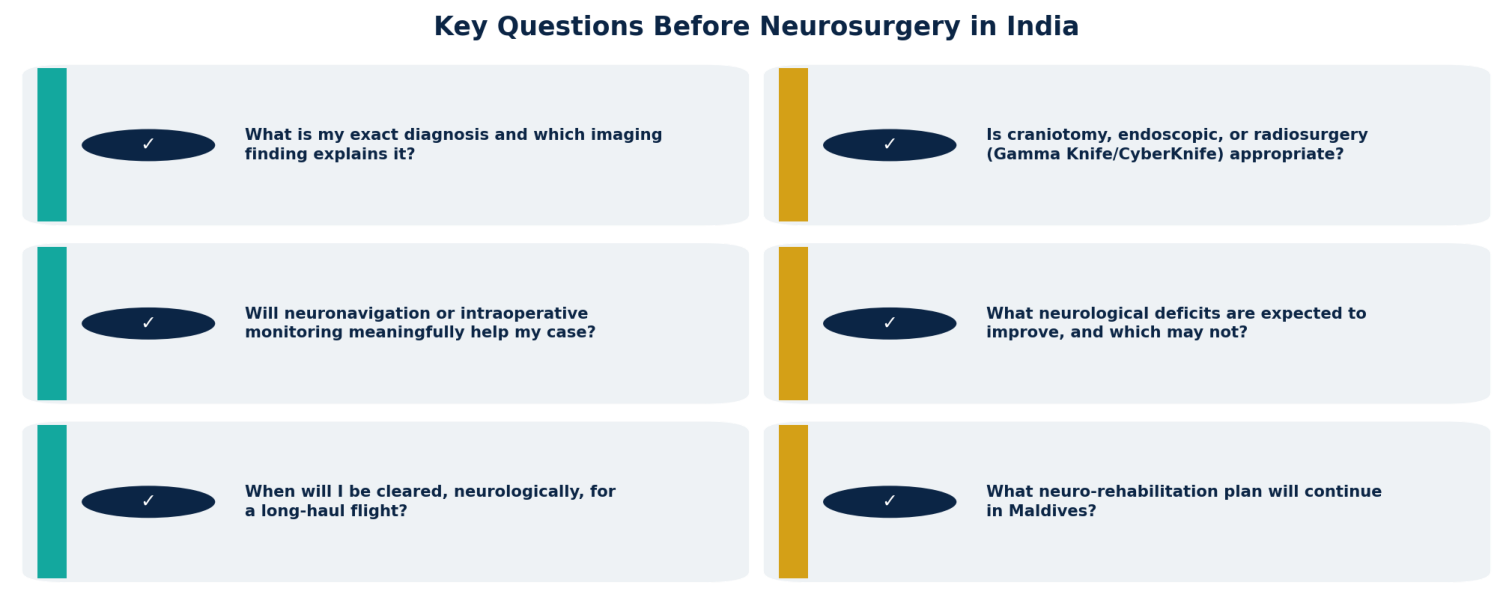
19. Questions Maldives Patients Should Ask Before Agreeing to Surgery in India
What is my exact diagnosis, and which imaging finding explains it?
Do I definitely need surgery, or is radiosurgery or observation appropriate?
Is craniotomy, endoscopic surgery, or radiosurgery (Gamma Knife/CyberKnife) appropriate for my case?
Will neuronavigation or intraoperative monitoring meaningfully help my case?
What neurological deficits are expected to improve, and which may not?
What are the major risks in my specific case?
How frequently does this surgeon treat this exact condition?
How long will I be hospitalised, and how long in India afterward?
When will I be cleared, neurologically, for a long-haul flight?
What neuro-rehabilitation plan will continue in Maldives?
Will I need long-term anti-seizure or other medication?
What is the plan if the condition recurs?
Frequently Asked Questions About Neurosurgery for Maldives Patients in India
Can my MRI or CT be reviewed before I travel from Maldives?
Often, yes. Digital images, reports and clinical information can be reviewed remotely before travel, though a definitive recommendation may still require an in-person neurological examination and updated imaging.
Does every brain tumour require surgery?
No. Some small, slow-growing or asymptomatic tumours are monitored with interval imaging, and some are better suited to radiosurgery than open surgery.
Is Gamma Knife or CyberKnife better than open surgery?
Neither is universally better. Radiosurgery avoids an incision and is suitable for selected tumours and vascular lesions, but larger lesions, those causing significant mass effect, or certain locations still require open surgery.
Is robotic or navigation-guided neurosurgery available in India?
Selected centres use neuronavigation, intraoperative imaging and robotic-assisted systems. Their relevance depends on the specific diagnosis and location.
How soon can I fly back to Maldives?
There is no universal timeframe. Your neurosurgeon should clear you based on neurological stability, wound healing, seizure control if relevant, and overall recovery.
Can I continue rehabilitation in Maldives?
Usually, yes. The Indian treating team should provide a rehabilitation protocol that can be shared with your doctor or therapist in Maldives.
What if I have already undergone neurosurgery before?
Further surgery or radiosurgery may still be possible depending on the situation. Send previous operative records and imaging for assessment.
Should I choose a hospital based on its technology alone?
No. Technology is one component. Procedure-specific surgeon expertise, correct diagnosis, and postoperative neuro-critical care remain fundamental.
Key Takeaway for Maldives Patients Planning Neurosurgery in India
Travelling from Maldives to India for neurosurgery is a major decision, particularly because postoperative recovery is followed by a long journey home. The most important step is not finding the most advanced-sounding technology. It is establishing the correct diagnosis and determining whether surgery is genuinely required, and whether a less invasive option such as radiosurgery is appropriate. When surgery is appropriate, the treatment should be matched to the pathology, and advanced technology used when it provides a meaningful benefit. For a Maldives patient, the treatment plan should also extend beyond the operating room to cover recovery in India, neurological fitness for long-distance travel, rehabilitation in Maldives, and a clear pathway for follow-up after returning home.
Maldives Patients — Ready to Take the First Step?
Share your medical reports from Maldives with our advisory team today and get a MEDICAL CONSULTATION, an indicative cost estimate in US$, and complete support — from your flight out of Malé to your recovery in India and follow-up back home.
Citation Block: Neurosurgery for Maldives Patients in India
Field
Details
Article / Topic
Neurosurgery in India for Maldives Patients — Complete Clinical & Surgical Guide
Primary Patient Group
Maldives patients with a brain tumour, nerve compression, a vascular brain condition or another complex neurological problem considering surgery in India
Key Clinical Principle
Confirm the diagnosis and whether surgery is genuinely needed before choosing any procedure
Conditions Covered
Brain tumours, cerebral aneurysms and vascular malformations, trigeminal neuralgia, hydrocephalus, drug-resistant epilepsy, movement disorders, spinal cord and peripheral nerve tumours, and head injury
Procedures Covered
Craniotomy, endoscopic neurosurgery, Gamma Knife and CyberKnife radiosurgery, deep brain stimulation (DBS) and endovascular neurosurgery
Technology
Awake craniotomy with intraoperative mapping, neuronavigation and intraoperative imaging, chosen to suit the condition rather than as a sales point
Tests Before Surgery
MRI, CT scan, CT or MR angiography, EEG, neuropsychological and functional assessment, and blood tests
Recovery
Hospital recovery followed by neuro-rehabilitation — physiotherapy, speech, occupational and cognitive therapy where relevant — and a return-to-work plan
Travel Home
Stay in India until neurological fit-to-fly clearance; take complete records and imaging back to Maldives
Key Decision Factor
Correct diagnosis, appropriate procedure, experienced neurosurgeon, safe recovery and follow-up in Maldives